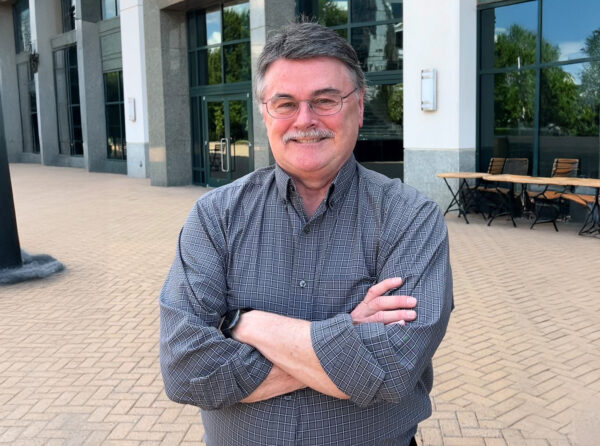
Brian Powers, P.E., has been evolving, learning, and tackling new concepts over the course of his 35+ year engineering career.
A process mechanical engineer for many years, he began his journey into water and wastewater treatment at the behest of a former employer. He took the challenge and the rest, as they say, is history.
He joined CEC in 2022 and currently serves as a Principal in the Manufacturing Infrastructure Services (MIS) group for the Water & Wastewater Treatment Group in our Charlotte office.
Brian has experience in engineering consulting and working with equipment manufacturers in the power and industrial sectors. His focus includes project management, design and process engineering for water and wastewater treatment systems, and balance of plant systems including cooling water systems, pumping systems, and compressed air systems. His technical focus includes process engineering and calculations, process flow diagrams, mass balances, P&ID development, detailed design engineering, equipment sizing and selection, piping specifications, equipment specifications, and hydraulic analysis.
He has experience with a variety of power and industrial balance of plant systems involving water and wastewater, along with extensive involvement in pressure hydraulic flow modeling and design of all types of pumping systems having successfully sized and selected thousands of pumps and fluid flow related systems.
He relishes the role of mentor within the MIS group. “I really enjoy the chance to be a coach.”
Brian earned a bachelor’s degree in Mechanical Engineering from Murray State University (Kentucky). He is a licensed professional engineer in North Carolina, South Carolina, and Virginia and a member of the American Society of Mechanical Engineers.
Here, Brian shares the evolution of his career and looks ahead to what’s on the horizon for the future of MIS. And offers this bit of advice, “don’t be afraid, go for it.”

How has your multidisciplinary background shaped your approach to solving complex engineering challenges?
It has provided me with the knowledge to provide successful projects by understanding various discipline requirements to complete a full design project. Whether you are proposing on a new project or implementing a design, you will require an understanding of structural, site civil, electrical, mechanical, process, controls and permitting for a successful project.
What advice would you give to young engineers looking to build a career that spans multiple disciplines like yours?
When you have a project assignment, dig into the technical details of everything that you do to gain a solid technical background. Don’t just look for answers to questions when presented with a design challenge. Also do not be afraid to ask for support from others with more experience than you may have. Push yourself for growth.
How do sustainability and environmental impact factor into your engineering decisions, especially in water and energy projects?
Environmental impacts for permitted discharges to POTWs (Publicly Owned Treatment Works) or to surface waters (NPDES) are becoming more restrictive and this increases our project opportunities for our industrial wastewater treatment team.
What emerging technologies or innovations are you most excited about in your field?
Treatment of PFAS which presents innumerable opportunities for wastewater treatment. Many of the treatment technologies for removal and destruction are new emerging technologies. We have completed several projects for PFAS removal and are also providing treatability studies in our Charlotte lab, as well as being involved in industry groups.
What role does data and digital modeling play in your work today compared to when you started your career?
Where do I start? The world of design is vastly different than when I started. We designed using draft boards. All calculations were by hand on a piece of paper, and we spent a lot of time in the field measuring when working on designs. Communication was by phone or letters. For urgent matters, my first company had a teletype room as another method of communication. A few years later, we bought a fax machine that was very large and slow. Most project meetings with clients were live. You drove or flew to your client’s office of site with drawings to review with them.
With the digital design that we have today it has increased our accuracy of designs and allows for changes to be made quickly. We often present our 3D design to clients during meetings to discuss designs and show progress.
Can you share a moment in your career that was particularly challenging or rewarding, and what you learned from it?
I am nearing almost 40 years of project experience and the first 20 years of my career were traditional mechanical process engineering design, including pumps and fluid flow, heat transfer processes, tanks, piping design, and process control.
I was asked by a former employer to develop a design for reverse osmosis system (RO) for a project. Having no background in water or wastewater treatment, this started my journey into water and wastewater engineering. I am a mechanical engineer and generally water and wastewater treatment engineers are chemical and environmental engineers. That began my journey as a self-taught water and wastewater engineer. I am glad I accepted this challenge as it evolved into a great, well-rounded career. I like doing water treatment and am glad to have chance to do it primarily here at CEC.
Post a Comment