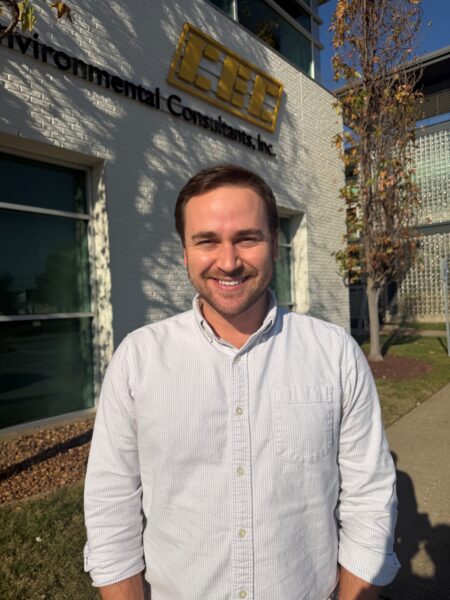
Drew Stokes, P.E., is the embodiment of the career trajectory possible at CEC.
He’s advanced from Staff Consultant to Project Manager II in his eight years since joining Nashville’s Civil/Site practice.
Starting as a design engineer, Drew immersed himself in diverse projects spanning commercial, institutional, municipal, and residential sectors.
“When I interviewed with CEC, it seemed like a good fit. As soon as I started, it became clear that I made the right decision,” he says.
His early work included schematic designs for high-profile developments like the Nashville Zoo’s River Safari and Komodo Dragon Exhibit, where he focused on innovative water reuse strategies and site planning.
As his expertise deepened, Drew advanced to Assistant Project Manager, taking on more responsibility in complex projects such as the Cool Springs Chick-fil-A redesign and Williamson County’s Material Recovery Facility. These roles honed his skills in permitting, grading, and stormwater management — critical components of sustainable site development. He also worked with Patrick Bennett, P.E., of CEC’s St. Louis office on numerous McDonald’s projects. “I have learned something new from each project. I’m still learning every day,” he adds.
In current role as a Project Manager II, Drew leads hydrologic modeling, erosion control design, and regulatory permitting for projects that shape communities across Tennessee. His portfolio includes major municipal utility improvements, USDA Rural Development-funded initiatives, and green infrastructure solutions that prioritize environmental stewardship.
Drew’s progression at CEC reflects more than technical achievement. It is a story of leadership and adaptability. From designing flood control levees to securing funding for wastewater treatment plants, his work demonstrates a commitment to solving real-world challenges with innovative engineering.
“Say ‘yes’ to anything presented to you and CEC will support you,” Drew says. He calls Bert Morton, P.E., and the Nashville Civil practice lead, his “go-to guy.” “I’ve worked with him since I started, and he’s been a great mentor.”
A graduate of the University of Tennessee at Knoxville with a Bachelor of Science in Civil Engineering, Drew is a member of the American Society of Civil Engineers and the Urban Land Institute.
In this Q&A, Drew reflects on the opportunities, challenges, and lessons learned along the way here at CEC.
What inspired you to pursue a career in civil engineering, and how did your education at the University of Tennessee shape your early professional path?
In my junior year of high school, I took a civil engineering and architecture course where we designed a library from start to finish. We worked on everything—from the layout and grading to insulation and even furniture selection. That experience got me hooked on both engineering and architecture. When I got to UT, I had to choose between the two. Since the architecture program was five years, I ultimately chose the shorter path and pursued civil engineering.
You’ve worked on a wide range of projects — from zoo exhibits to municipal water systems. Which project challenged you the most and why?
Zoo exhibits are a beast to work on. The hydrology is always challenging because the berms and moats double as animal containment systems. You end up using extremely unique strategies to detain and treat stormwater, especially when animal waste becomes a factor.
As a young engineer, how did you transition into project management roles so early in your career? What skills helped you succeed in those positions?
It was trial by fire. I made mistakes, but I always felt supported by senior staff. Being able to balance seeing the big picture while staying detail-oriented made the transition easier. And saying yes to opportunities, even when they pushed me out of my comfort zone, was huge.
Your work often involves regulatory permitting and coordination with city and state agencies. What have you learned about navigating these processes effectively?
I’ve learned that most regulators genuinely do want to help you. I always try to ask follow-up questions whenever possible to make sure expectations are clear on both sides.
Can you share a project where your use of low impact development or green infrastructure made a significant difference in the outcome?
I designed an affordable apartment complex in Franklin, TN, where the site had very limited space, so we incorporated permeable pavers throughout the parking lot. To reduce runoff, we relied on the infiltration capacity of the soil beneath the pavers. Without them, the project would have required much more detention area, which likely would have meant removing one or two buildings. The project probably wouldn’t have moved forward with fewer units.
You’ve contributed to both public and private sector projects. How do the goals and challenges differ between these types of clients?
Public sector projects give you a sense of helping a large number of people. For example, I’m currently working on a water line extension for a rural utility that will bring potable water to an area without access to public drinking water. On private-sector jobs, the reach is less broad, but I’m still helping people meet their goals—just on a different scale.
What advice would you give to recent engineering graduates who want to build a diverse and impactful project portfolio like yours?
Say yes to opportunities, no matter how intimidating they seem. And don’t be afraid to ask questions, it’s one of the fastest ways to grow.
Post a Comment