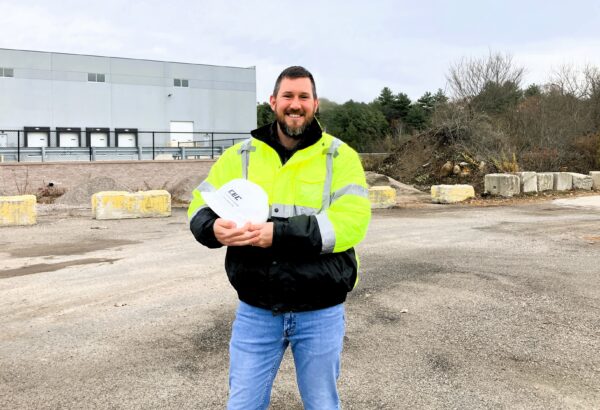
When Chris Dohner, P.E., stepped into the role of Corporate Waste Practice Lead at CEC earlier this year, it was the latest chapter in a career that’s been steadily on the rise since he joined the company in 2012. Starting as a Staff Consultant and climbing through multiple project management roles, his journey is a great example of growth through dedication and leadership.
Though his title has changed, Chris continues to manage major projects and remains hands-on with technical work, in addition to his responsibilities as the Corporate Practice Lead.
He is intentional about how he manages his time, blocking out hours on his calendar for practice-related work and keeping a running list of goals and action items. It’s a system that he started years ago to stay current on invoicing and evolved into a broader strategy for staying organized and responsive.
The new role, however, has opened up space for broader initiatives — mentorship, long-term planning, and shaping the direction of the practice. He’s focused on building consistency across offices and creating opportunities for younger staff to share their ideas and take on leadership roles.
Chris sees value in the different ways people approach problems depending on their experience. Whether someone is two years or 25 years into their career, he believes there’s something to learn from each perspective. His goal is to bring those voices together to create more efficient and thoughtful solutions.
One of his priorities is identifying emerging talent and pairing them with mentors who can help them grow. Through monthly meetings with office leads and visits to CEC offices with waste practices, Chris is working to make sure those individuals feel seen, heard, and supported.
This emphasis on developing future leaders is vital and necessary for the continued growth of CEC. “Some staff members are unsure of how to get involved. That’s what I want to change,” he says.
Now, he’s focused on creating space for others to find their own path. “I don’t want to tell people what their goal should be,” he says. “I want to provide the opportunity and support for them to develop and pursue their passion.”
Here, he reflects on how his responsibilities have shifted, what he hopes to accomplish, and why listening to staff across all levels is central to his approach.
 What inspired you to pursue a career in civil engineering, specifically in solid waste management?
From a young age, I was always curious about nature and the sheer power of water. I grew up in Dayton, Ohio, and lived a few miles away from a man-made reservoir and earthen dam which my parents would frequently take me to visit throughout the year. These experiences allowed me to appreciate the connection between large civil engineering projects and the surrounding beauty of the ecosystem. As I entered college, my curiosity turned to providing engineering solutions to help the public, while also protecting and ensuring the longevity of the world around me. At the conclusion of my sophomore year of college, I completed an internship with a consulting firm, during which I performed construction quality assurance (CQA) at a landfill. That internship experience gave me the opportunity to communicate with industry professionals and solidified my decision to pursue a career in the waste management industry providing safe and innovative solutions to benefit and protect the public and environment.
With more than 16 years of experience, what major changes have you observed in landfill design and environmental regulations?
From a design and permitting perspective in the Northeast, capacity and available land for new solid waste facilities continues to decrease, requiring engineers to find unique and innovative solutions to integrate existing facilities and infrastructure into new designs that meet current regulatory requirements and environmental concerns. It is not uncommon for engineers to retrofit infrastructure constructed in the 1970s and 1980s to meet current industry and regulatory accepted design standards. Engineers and waste management companies continue to research and utilize new geosynthetic products such as ClosureTurf and Agru Super Gripnet Liner to protect the surrounding environment while providing a necessary public health service.
ClosureTurf is final cover geosynthetic material that utilizes an artificial turf and sand infill instead of a traditional soil and geosynthetic final cover system. The ClosureTurf material reduces the amount of soil needed to complete projects and also limits the potential for future soil erosion and repair after the final cover is constructed. Agru Super Gripnet, and other variations, are geomembrane liners with specially formed spikes which allow the material to be installed at steeper slopes and maintain shear strength at higher normal loading (i.e., waste depth) than traditional textured geomembranes.
From a regulatory perspective, the promulgation of regulations regarding PFAS and environmental justice communities has had a profound impact on the solid waste industry. After the initial introduction of federal PFAS regulations, states have begun to promulgate their own standards which are often more stringent than federal guidelines and may include regulating additional compounds. Additionally, some states already require PFAS testing or will require the inclusion of PFAS testing when the facility next applies for a new permit or permit renewal. This development has caused most facilities to update their environmental monitoring plans and protocols to, at a minimum, include PFAS testing and reporting, if not construct and operate wastewater treatment plans at the facility.
Environmental justice provides for fair and equal treatment of those communities disproportionately affected by an industry using laws, regulations, and policies to ensure equal protection and opportunity for participation of these communities during the permitting and decision-making process. New federal and state specific regulations and policies sought to further define marginalized communities, require additional efforts by industries to provide equal opportunity to participate in the decision-making process and also established approved public resources to ensure the regulations were being followed equally.
A solid waste industry project usually starts with a determination of communities that fall under the environmental justice regulations, the appropriate outreach required, and an approved outreach plan to confirm compliance with the laws, regulations, and policies. Each project starts with this process to ensure the voice of the surrounding community is heard and the project moves forward positively for all stakeholders.
How do you approach quality assurance and regulatory compliance across multi-state projects, especially with your professional registrations in MA, NH, and NY?
Quality assurance and compliance require a systematic process of documentation and review to ensure projects meet the standards of approvals, regulations, and expectations of the project owners and regulators. My approach is to first confirm that the project team has the approved documents which describe the project requirements and then review those documents in detail. During document review, I’ll make notes for overlapping, duplicative, and ambiguous requirements, requirements I don’t understand, specific deadlines, and responsible parties. This information is then added to a spreadsheet which can be updated and viewed by the entire project team as appropriate (CEC, client, contractor, other consultants and subcontractors, etc.) and discussed at routine project meetings.
Prior to preparing the spreadsheet, it is important to confirm full understanding of all the project requirements. If I am unsure, I will reach out to other experienced CEC leaders, the client, and possibly the regulator (after consulting with the client first), to confirm that we agree on the intent of the language used in the approval.
Another key step after preparing the initial spreadsheet is to routinely review, update, and track the progress of each task so that requirements are confirmed complete throughout the project. This reduces the potential of identifying an issue after completion at which point, it may be extremely difficult or impossible to gather the required information.
When working on multi-state projects or more typically projects with federal, state, and local requirements, this approach can properly describe and track all requirements and responsibilities to lead to a successful project and approval for the client.
As a professional engineer registered in multiple states, it is ultimately up to me to make sure that I fully understand each state’s regulations and requirements, seek guidance from appropriate sources when questions arise, and involve industry experts when needed to ensure quality and compliance for some of CEC’s clients’ more complex projects.
At CEC, you’ve progressed from a Staff Consultant to the Corporate Waste Practice Lead in just 13 years — what key decisions helped shape that journey?
I believe my progression at CEC is reflective of opportunities provided by the Boston office lead (Barry VanLaarhoven) and office practice lead (Amy Knight) and my personal determination to actively pursue professional and personal growth at CEC. Early in my career, I was given opportunities to be the office health & safety coordinator, the radiation safety officer (RSO), submit abstracts for presentation at national conferences, participate in interviews, and mentor the practice staff. The discussions I had with senior leadership, and the support and confidence they showed allowed me to feel comfortable stretching myself to ascend at CEC. It also made me comfortable to define my own career path and pursue what was important to me such as mentoring staff and planning for the long-term development of initially the Boston Waste Management practice and now the corporate Waste Management practice.
Ultimately, knowing what I wanted for my career, advocating for myself, having the support of other leaders, and being confident when given the opportunity has led me to being the corporate practice lead.
What advice would you give to young engineers entering the field hoping to follow a similar career trajectory?
My biggest pieces of advice would be to ask questions, be curious, and seek guidance. I have found that everyone at CEC is willing to answer questions related to engineering design, project management, professional and client development, etc. If you have a question, someone has most likely had the same question or has had an experience which will help you. Never be afraid to ask a question or start a conversation with someone, even if that person is the CEO. Everyone at CEC wants you to succeed and prosper.
Post a Comment