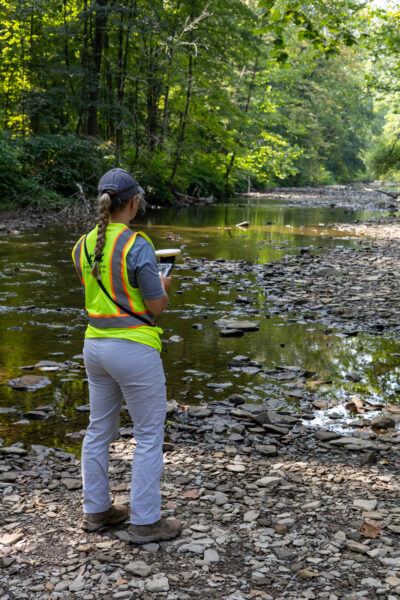
Most people overlook the impact that wetlands have on the environment, but for Alex Casile, a Project Scientist in the Ecological Sciences practice, identifying and protecting wetlands is an important part of her everyday job. As we made our way to a stream so that Alex could perform a mock delineation, she listed the benefits that wetlands have to offer: “They filter water, they’re big carbon sinks, they hold so much plant biodiversity, and they’re great habitats for frogs and salamanders to reproduce.” The United States Environmental Protection Agency even refers to them as “biological supermarkets” because of how much food they provide for a variety of animal species, from the bottom of the food chain to the top.
Alex has been working at CEC since November 2021 after graduating from Thiel College with a bachelor’s degree in environmental science and a minor in wildlife biology. Now, she mainly leads wetland delineations and rare plant surveys.
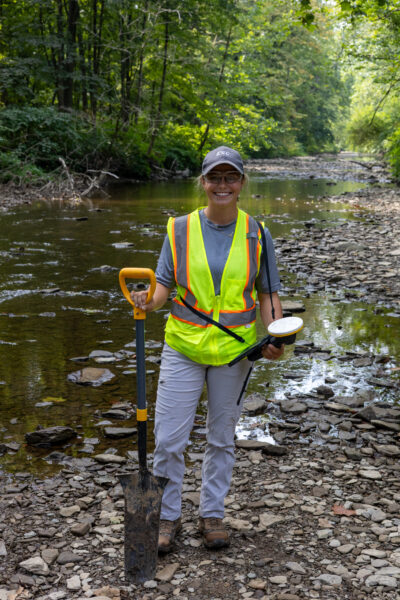
 Alex took us to Montour Woods Conservation Area, a quick ten-minute drive from the CEC headquarters in Pittsburgh. She laced up her boots and donned the required bright yellow vest and safety glasses before heading into the woods, on the search for wetlands. “Sometimes they’re not obvious,” she said. “There have been some areas where I’ve walked across and didn’t think it was a wetland, until I looked at the soils and started investigating more.”
There are a lot of misconceptions regarding wetlands. “A lot of people don’t really know what a wetland is. They say, ‘Well, there’s no water, so that’s not a wetland,’” Alex said, then explained that an area must have three things to qualify as a wetland: hydrology, hydric soils, and hydrophytic vegetation. “On our wetland data form, we have a bunch of things that are considered hydrology. Some of them include surface water, water table, water-stained leaves, saturation…Even drainage patterns, moss lines, and crayfish holes—those are all hydrology indicators.” 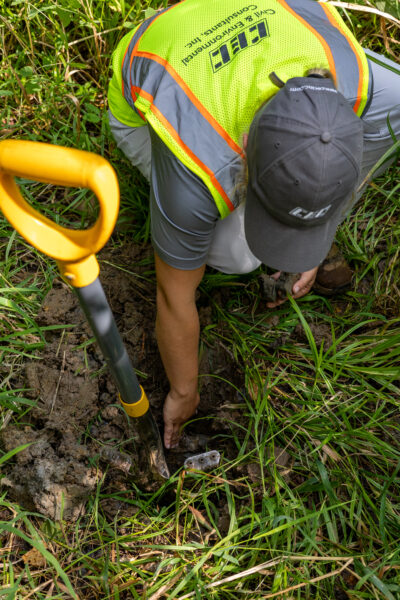
Alex cleared a path, pushing away leaves and branches, then began digging a small test pit in the soil in a seemingly dry area a few yards from the main stream. When she reached a point where she could no longer dig—which she later explained was another hydrologic indicator known as a shallow aquitard, meaning there is a layer of bedrock holding the water up—she scooped the soil in her hands.
“That’s the oxidized rhizospheres,” Alex said, noting the slight orange tint to the soil. When air leaks into the soil through the vegetation roots, it causes the iron compounds in the soil to oxidize. She also pointed out how water was beginning to seep out at the bottom of the hole, another indicator of hydrology.
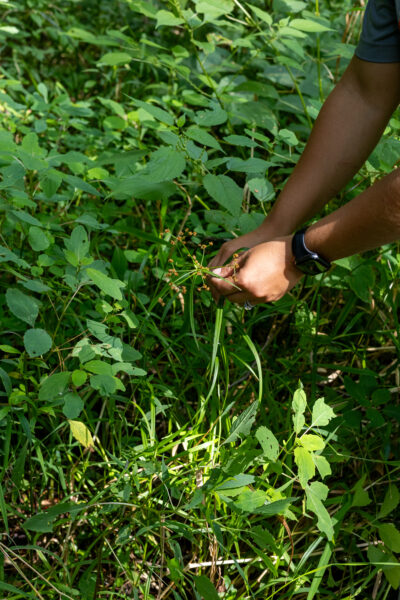
Lastly, Alex pointed out some nearby vegetation that is common to wetlands, including Scirpus atrovirens, small-spike false nettle, and box elder. She held out a stalk of Leersia oryzoides, also known as rice cutgrass, to show the short, spiky hairs along the stem.
When wetlands are impacted, CEC helps clients by permitting or creating mitigation banks to limit harm being done to the environment. Alex spent much of the summer visiting mitigation banks, conducting vegetation monitoring to make sure they were diverse and growing, but free of invasive species.
On the walk back to the truck, Alex remarked on the reception she gets when she tells people what she does for work: “People say, ‘Oh, it’s so awesome that you get to be outside all day!’” But she also has to face adverse weather, including rain, snow, and heat—not to mention things like ticks and spiderwebs. The previous day, she walked 16,000 steps in the field, so spending her Friday in the office is a nice break before the weekend. Still, Alex thinks her job is pretty rewarding: “I genuinely love what I do.”

Post a Comment